Detail note · 18 November 2026
Brass or 304 stainless: choosing the tube for a glazing and bathroom project
Brass and stainless look similar in a photograph and behave differently in a bathroom. The choice is about chlorides, coating adhesion, thread strength and the finish you can actually maintain.
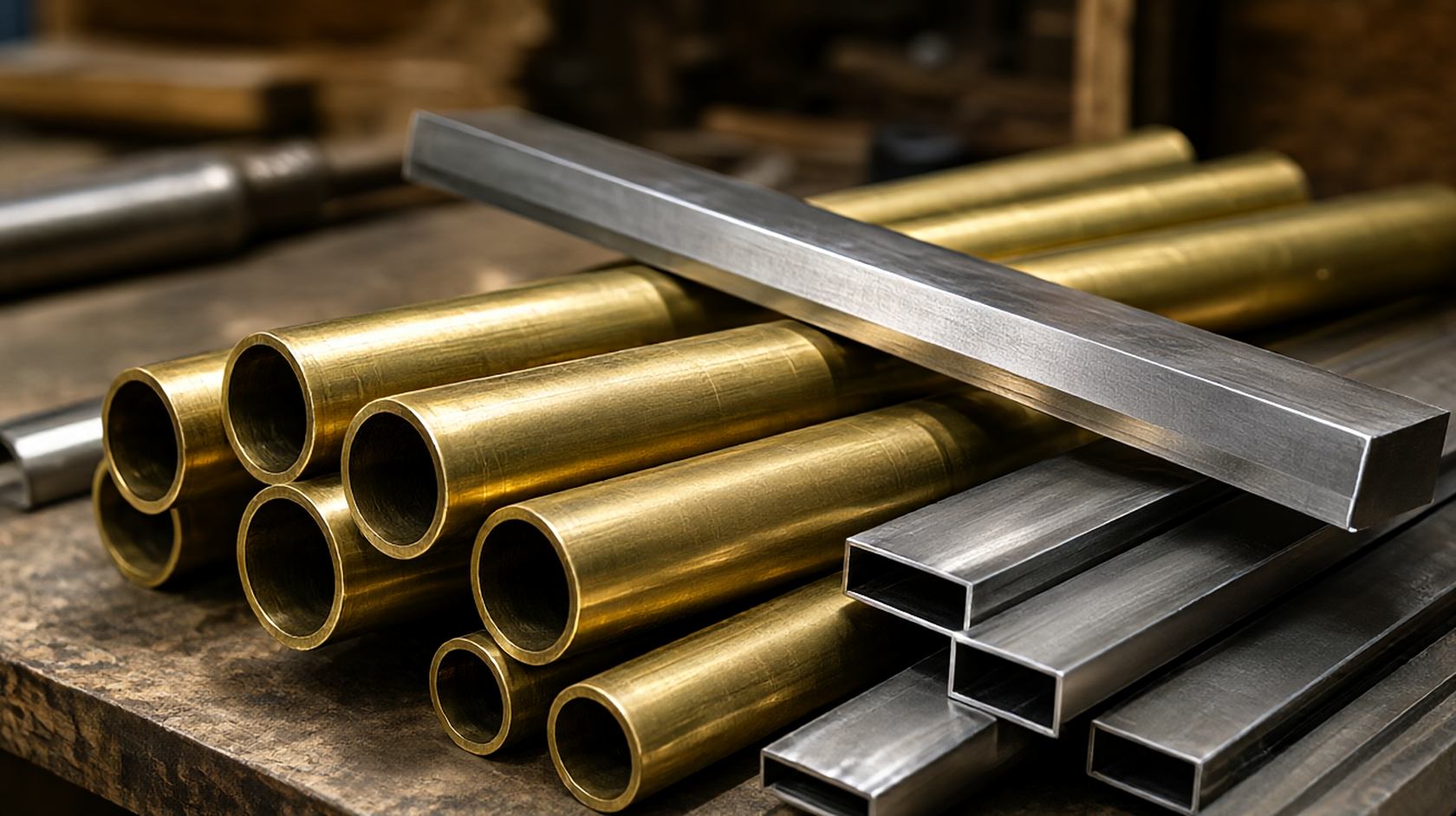
What the two materials actually are
Brass is a copper-zinc alloy, often with a small lead content for machinability, and it is usually plated - chrome, nickel or a powder coat - when it appears in a bathroom. Stainless steel 304 is an iron-chromium-nickel alloy used bare or brushed, with no plating to wear through.
The practical difference in a glazing project is that brass is easy to machine and to join, and stainless is easy to keep clean. Brass gives you a wide range of fittings and decorative finishes; stainless gives you corrosion resistance and a finish that does not peel.
The specification question is therefore not 'which is better' but 'which failure can this project tolerate'. A peeling chrome on a decorative brass rail is ugly; a pitted 304 in a chloride environment is structural.
Chlorides decide the stainless grade
304 stainless is the default for interior fittings and it is adequate for residential bathrooms and most commercial washrooms. It is not adequate for swimming pools, coastal buildings or industrial cleaning with hypochlorite, where chlorides cause pitting and stress corrosion cracking.
In those environments the correct grade is 316, and the fasteners and any welded joints must match. A 316 tube with 304 screws is a galvanic couple at every fixing point, and the screws will fail first.
Brass performs differently: it resists chlorides better than 304 in many bathroom environments, which is why brass fittings survive in old bathrooms where stainless would pit. The trade-off is that brass is softer, so threads and moving parts wear faster.
Threads, joints and the strength question
Brass threads are easier to cut and to seal, and they are more forgiving of a slightly damaged fitting. Stainless threads gall and seize if they are assembled dry, and a seized stainless joint is usually destroyed to remove it.
For structural connections - a bar that people pull on, a tube that carries a panel - stainless has the higher yield strength and the better fatigue behaviour. For decorative connections and low-load assemblies, brass is adequate and easier to work.
Where the two are mixed - a stainless tube with a brass connector - the joint needs an isolator or a deliberate choice of compatible materials. A brass fitting on a stainless tube in a wet environment is a small galvanic cell, and it will show as corrosion at the joint within a few years.
Finish and maintenance
A brushed stainless finish hides scratches and water marks, and it can be restored with a non-abrasive cleaner. A polished finish shows every fingerprint, which in a hotel bathroom is a maintenance cost rather than a design choice.
A plated brass finish has a service life: the plating thickness, the adhesion and the cleaning chemicals decide how long it lasts. In a bathroom cleaned with acidic descalers, a thin chrome will fail at the edges first, and the failure looks like a stain rather than a coating defect.
Powder-coated brass or aluminium is a third option: colour matching is easy and the coating hides the base metal. The weakness is at the cut edges and at the fixings, where the coating is thin or absent.
Specifying by location, not by preference
The practical approach is to specify material by zone: dry interior (304 or brass, finish by design), wet interior (304 with a brushed finish or 316 where chemicals are used), coastal or pool (316 throughout), and industrial cleaning (316 or a suitable plastic).
State the fasteners with the material and state the cleaning chemicals the fixture must tolerate. A specification that says 'stainless' without a grade and a cleaning regime has left the decision to whoever is buying that week.
The tube sizes follow the load and the look: 19 mm round and 15 mm square are the common profiles for bathroom rails and glazing support, and the wall thickness matters more than the outside diameter for anything that carries a person's weight.
The cost comparison that is honest
Brass is usually more expensive per kilogram than 304 and cheaper to machine; stainless is cheaper per kilogram and more expensive to finish. The installed cost often lands close, which is why the decision should be made on performance rather than on the metal price.
The whole-life comparison includes the maintenance cost of the finish and the replacement cost of the first failure. A plated brass rail replaced at year eight is a different number from a brushed stainless rail that is still in service at year fifteen.
The final question is what the client will notice. In a residential project, the finish and the feel matter; in a commercial project, the maintenance schedule matters. Both are legitimate, and both should be written down before the order.
Coating, colour matching and the repair nobody can do
Colour matching across a project is harder than it looks. Two batches of the same finish can differ, and a replacement bar ordered two years later will often be a visible mismatch on a large glass door.
The practical answer is to order spares with the original batch. One extra bar and one extra set of clamps, kept with the building's maintenance stock, solves the mismatch problem that cannot be solved later.
Repair is limited: a scratched brushed stainless can be re-grained by hand, a scratched polished finish cannot be restored on site, and a chipped powder coat can only be touched in.
The specification sentence that prevents most problems
One sentence does most of the work: the material, the grade, the finish, the fasteners and the cleaning chemicals it must tolerate. Everything else in the schedule is a consequence of those five items.
Projects that write that sentence get comparable quotes. Projects that write 'chrome finish, as discussed' get three different products and an argument at handover.
The tube is the visible part, but the fixing is the part that fails. Specifying the fixing as carefully as the tube is the difference between a rail that lasts and a rail that is replaced.
Wall thickness, weight and the feel of quality
Two 19 mm tubes can look identical and feel different because the wall thickness differs. A 1.0 mm wall is a decorative tube; a 1.5 mm wall is a rail.
The thickness also decides how the tube behaves at a fixing: a thin wall crushes under a grub screw, and a crushed tube cannot be re-fixed in the same place.
For anything a person leans on, specify the wall thickness rather than the outside diameter alone. The catalogue usually lists both, and the cheap version lists only the diameter.
The order of decisions on a real project
Decide the environment first, then the material, then the finish, then the fixing, then the profile. That order matches the failure modes: environment causes corrosion, material decides whether it can be prevented, finish decides appearance, fixing decides whether it stays put.
Reversing the order - choosing the look first and the material last - is how a polished chrome rail ends up in a swimming pool changing room.
The profile is last because it is the least consequential decision. A 19 mm round and a 15 mm square look different and perform almost the same at the loads a bathroom rail sees.
The sample that prevents the argument
Send a physical sample of the finish, not a photograph. Two brushed finishes with different grain direction look identical on screen and different on a door.
Keep the approved sample on site until handover. It is the only reference that settles a dispute about whether the delivered rail matches what was specified.
Take the sample from the production batch if the project is large. A sample from a different batch proves the finish exists, not that the delivered goods match it.
Record the batch on the order and on the handover file. If a replacement is needed in year three, the batch number is what tells the supplier which finish to match, and without it the replacement is a guess.
The profile that suits rails and glazing supports in these projects is the 19 mm brass round pipe, used where the finish matters more than the section and the environment is not chloride-heavy.
What to check
- Coastal, pool or hypochlorite cleaning means 316, with matching fasteners.
- Do not mix brass fittings and stainless tubes without an isolator.
- State the finish and the cleaning chemicals the fixture must tolerate.
- Wall thickness matters for load-bearing rails, not just outside diameter.
- Compare installed cost and finish maintenance, not metal price per kg.