Detail note · 18 November 2026
Glass door handles and locks: pull force, cylinder choice and the detail that fails
A handle on a glass door is a small lever acting on a brittle material. The pull force, the hole pattern and the way the lock clamps decide whether the door feels solid or whether the glass eventually chips at the fixing.
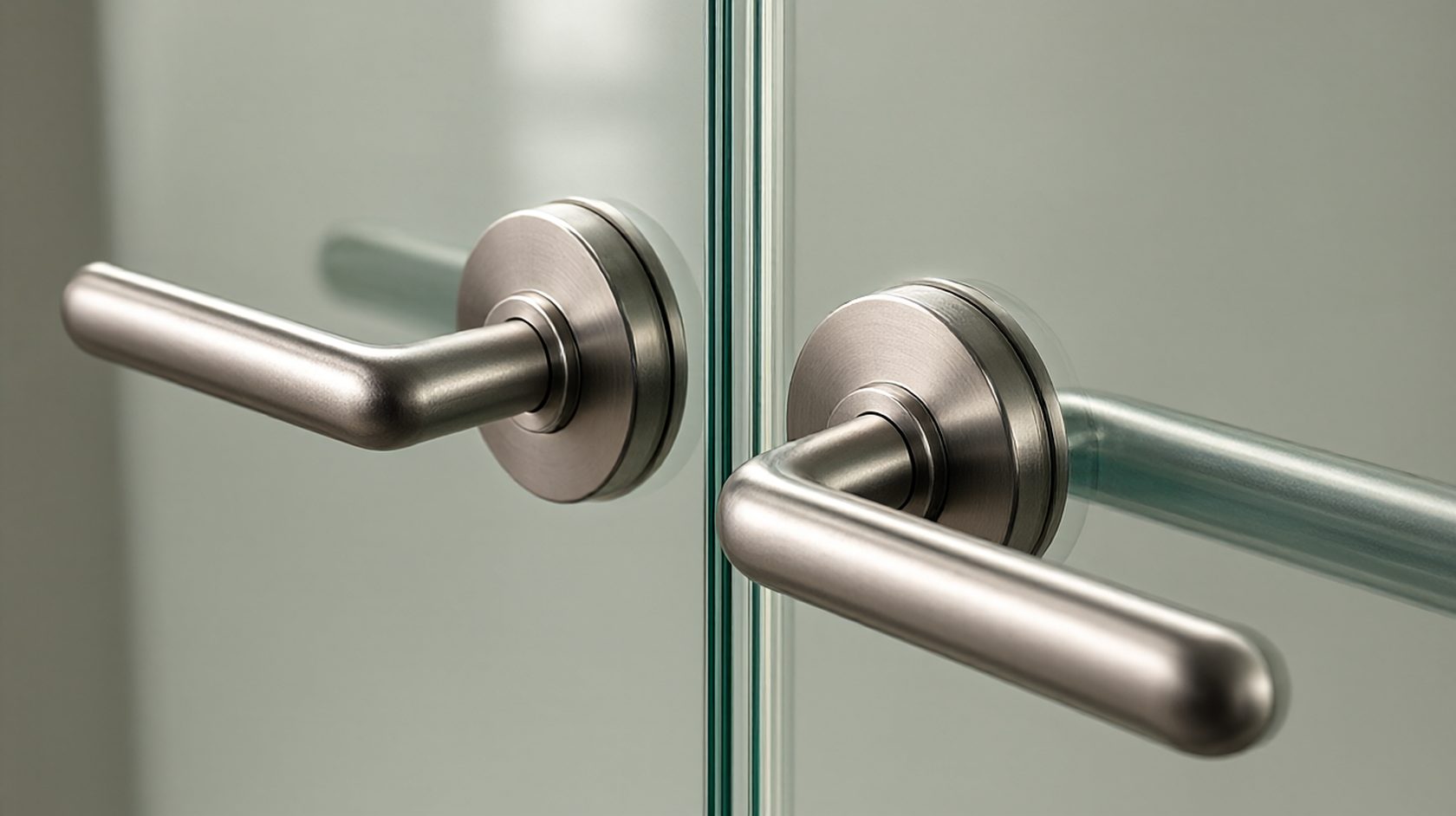
The pull force is the design load
A person opening a door pulls with 200 to 400 newtons, and on a stiff closer or a heavy panel the peak can be higher. That force is applied at the handle, which is an offset lever on a hole in tempered glass. The hole is the weak point.
The load path is: hand to handle to clamp to glass to the second clamp on the other side. A back-to-back pair shares the load; a single-sided pull handle does not. This is why commercial glass doors use pairs and why a single-sided handle on a 12 mm door is a design compromise rather than a specification choice.
The handle's grip length matters too. A short handle concentrates the hand at one point, and the pull is less controlled; a longer grip spreads the hand and reduces the peak force. The comfort argument and the structural argument point the same way.
Hole pattern and edge distance
Glass door handles mount through two holes, and the spacing is fixed by the handle. The centres must match the glass exactly, because a hole at the wrong spacing cannot be moved after tempering. Standard centres exist, and a non-standard handle means a made-to-order glass panel.
Edge distance from the hole to the door edge and to the top or bottom of the glass is equally fixed. The rule of thumb is at least one glass thickness plus the hole radius, and manufacturers often require more. A hole closer than that concentrates stress and produces a crack that starts at the hole and runs to the edge.
The hole diameter is set by the handle's through-bolt or spindle. A hole that is too large leaves the clamp bearing on a small annulus; a hole that is too small will not accept the fitting. Both are avoided by ordering the hardware before the glass and giving the glass supplier the hardware's drilling drawing rather than a verbal description.
Locking a glass door
A glass door lock is either a cylinder in the handle backplate, a floor lock, or a patch lock at the edge. The handle-mounted cylinder is the most common in office interiors and the easiest to retrofit, because it only needs the existing handle holes.
The cylinder choice is a security decision and a key-management decision. A euro profile cylinder in a glass door should be a security cylinder with a sacrificial break point, because a cylinder that projects from the door is the classic attack point. On a glass door, the projection is also a snagging risk.
The lock needs a strike, either in the frame or in a fixed glass panel. A strike in a fixed glass panel is a patch with a keeper, and its position must be set before the fixed panel is tempered. The latch engagement depends on the door's rest angle and the closer setting, which is why a door that closes slightly short will not lock no matter how good the lock is.
Finish, corrosion and the bathroom problem
A 304 stainless handle in a residential bathroom will survive indefinitely if it is cleaned. The same handle in a commercial pool building or a coastal project will pit, because chlorides attack 304. The specification answer is 316 stainless in chloride environments, and it is a decision made at the schedule, not at the merchant.
The finish matters as much as the grade. A brushed finish hides scratches and fingerprints; a polished finish shows every touch and every water mark. In a high-traffic office the brushed finish is the practical choice, and the polished version is usually specified once and regretted for years.
Plating is a different risk. A chrome-plated zinc handle looks like stainless and fails like zinc: the plating wears at the edges, the base metal corrodes, and the handle looks tired at year three. On a glass door where the handle is the thing people touch, that is a visible failure.
Installation and the gasket question
Every clamp that touches tempered glass needs a gasket or a plastic isolator, both to protect the glass and to prevent a galvanic couple with any aluminium in the assembly. A metal clamp tightened directly onto glass is a stress riser and a chipping risk.
The tightening sequence is staged, alternating between the two sides, and the torque is modest. A handle clamp tightened by feel will often be tight on one side and loose on the other, which shows up as a handle that rocks slightly under hand.
After installation, test the pull with the door closed and with the door held open against the closer. The closed test checks the fixing; the open test checks the clamp under the worst lever. A handle that moves under either test is not finished.
The maintenance that is actually needed
Handles need two things: cleaning with a non-abrasive agent, and a check that the clamps remain at torque. The check matters because a loosening clamp is the first sign of a hole that is chipping, and catching it early saves a panel.
Locks need lubrication that suits the environment and a key schedule. A cylinder that is dry in a humid bathroom will seize; a cylinder lubricated with the wrong product will collect dust and seize anyway.
The whole assembly - handle, lock, closer - should be reviewed once a year against the door's behaviour. A door that needs a second push to latch, or a handle that has developed a slight movement, is telling you which component is next to fail.
Key management and the cylinder schedule
A glass door lock is one lock in a building full of them, and the cylinder should be part of a key schedule rather than a purchase made at the last minute. A cylinder that cannot be keyed alike with the rest of the floor is a cylinder that will be replaced within a year.
The schedule needs the cylinder type, the length, the cam and the finish, and it needs to be agreed with whoever holds the master key. On a commercial fit-out that is usually the facilities team, and they will have a preferred profile.
Master-keying a glass door has one extra constraint: the cylinder must not project far enough to be attacked or to catch clothing. A cylinder that stands 15 mm proud of the backplate is the compromise that keeps the key schedule workable without turning the door into a security weakness.
When the door is the only lock in the room
In a small office or a fitting room, the glass door lock is the only privacy control. That changes the specification: the latch must engage reliably, the indicator must be visible, and the emergency release must be accessible from outside.
A lock with an emergency release is not a luxury; it is what makes a glass door safe when a child or a customer closes it. The release should be a coin-slotted or a thumb-turn type that works from outside without a key.
The strike position follows the latch, and on a glass-to-glass arrangement the keeper is a patch that must be set before tempering. That is one more reason the lock is chosen with the hardware schedule rather than after the door is hung.
The gap between the door and the frame
A lock needs a consistent gap at the latch - typically 3 to 5 mm - and that gap is set by the hinges and the strike, not by the lock. A door that has dropped 4 mm will not latch no matter how the cylinder is adjusted, and the fix belongs at the hinge.
The pair described here - clamped back to back through two holes, with a cylinder in the backplate - is the stainless steel glass door handle with lock used on office doors, and it is the configuration the hole pattern should be drawn around.
What to check
- Match hole centres and edge distances to the hardware drawing before tempering.
- Specify back-to-back pairs on commercial doors; single-sided is a compromise.
- 316 stainless where chlorides are present; brushed finish in high-traffic areas.
- Isolators or gaskets at every metal-to-glass clamp.
- Test the pull closed and held open against the closer.