Detail note · 18 November 2026
Suction lifters: two cups or three, and the safety factor behind the number
A suction lifter is a lifting device with a published safety factor, and the factor assumes a clean, flat, dry surface. Two cups or three is a question about redundancy, not about capacity.
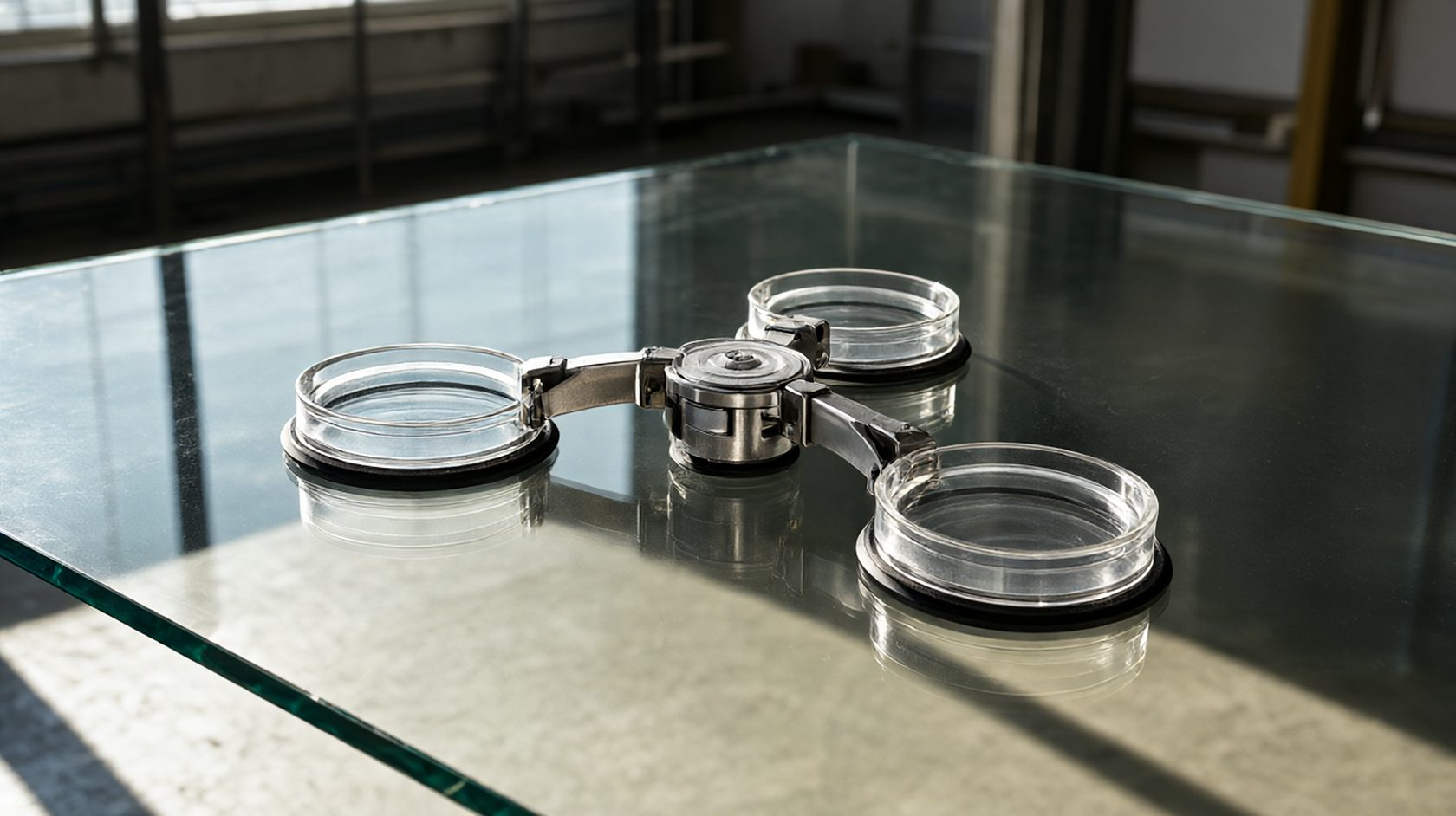
What the safety factor actually means
A suction cup holds a load by differential pressure: the pump removes air from under the cup, the atmosphere presses the cup onto the glass, and friction plus the pressure difference carries the load. The holding force is the cup area times the pressure difference, with a factor for the seal and the surface.
Lifter manufacturers publish a working load, and that working load already includes a safety factor - typically two to three times the calculated holding force for a horizontal lift, more for a vertical lift. The factor exists because a cup can lose vacuum slowly, because glass can flex away from the cup, and because a person can jerk a load.
The number that matters is therefore not the cup diameter but the rated capacity of the lifter as an assembly, at the orientation you will use. A two-cup lifter rated for 100 kg horizontal may be rated for far less when the glass is carried vertically, because the load then acts to peel the cups off rather than press them on.
Two cups or three
Two cups are the minimum for a flat panel: two points define a line and allow the panel to be tilted and carried. Three cups add redundancy and stability, and they are the practical choice for larger panels where a single cup losing vacuum would let the panel rotate.
The redundancy argument is real. With two cups, losing one means losing control. With three, losing one leaves two carrying the load and an audible warning from the vacuum gauge, and the operator has time to set the panel down.
Three cups also suit panels with holes or cut-outs, because the cups can be positioned around the opening rather than on it. A cup on a hole holds nothing, and a cup over a hole in tempered glass is also a stress point.
The surface is part of the machine
A suction cup needs a clean, flat, non-porous surface. Dust, oil, water or a textured film (frosted, sandblasted, coated) reduces the seal and the holding force. On coated glass, the coating can be damaged by the cup, and the cup can slip on a low-friction coating.
The preparation is simple: wipe the glass where the cup will sit, dry it, and check that the cup sits flat without rocking. On a construction site, that step is the one that gets skipped, and it is also the step that determines whether the lifter holds.
Temperature matters too. A very cold panel can make the rubber seal stiff and the seal imperfect; a very hot panel in direct sun can soften the seal. Neither is a reason not to lift, but both are reasons to check the vacuum gauge before the load leaves the ground.
The vacuum gauge and the pump
A lifter without a gauge is a lifter you cannot trust. The gauge tells the operator whether the seal is good before the load is lifted, and it shows a slow loss during the carry, which is the warning that a cup is leaking.
The pump type matters for the working rhythm: a manual pump is reliable and slow, an electric pump is fast and needs power, a venturi pump needs compressed air and is the lightest option. On a site with no power at the lift point, a manual or venturi lifter is the practical one.
The check valve and the reserve tank are the safety features that let a lifter hold a load after the pump stops. A lifter that depends on continuous pumping is a lifter that drops the load when the operator's attention moves.
Lifting technique for large panels
Large glass is lifted with the panel vertical or near-vertical, with two people: one operating the lifter and one guiding the panel. The lifter carries the weight; the second person controls the rotation and prevents the panel from swinging into a frame.
The panel should be lifted just clear of the ground and held for a count of five before moving. That pause is the moment when a marginal seal reveals itself, and it costs five seconds against the cost of a dropped panel.
Never lift a panel by a single cup, and never use a lifter as a clamping device for drilling or cutting. Vibration and lateral force are outside the design case, and a cup that slips under a side load takes the glass with it.
Storage, transport and the end of life
The lifter itself is a fragile tool: the cups deform, the seals harden, the gauge drifts. Store it with the cups protected, away from sunlight and solvents, and check the seals annually.
A seal that is hard, cracked or glazed should be replaced before the next lift, not after. Seals are consumable and inexpensive; a dropped panel is neither.
The lifter's rated capacity should be marked on the tool and re-checked against the panel weight each time. The failure mode in the field is not a bad lifter, it is a good lifter used on a panel that was heavier than the last one.
What a dropped panel costs, and the procedure that prevents it
A dropped tempered panel does not bend; it shatters into thousands of pieces and the fragments travel. The cost is the panel, the downtime, the cleanup, and - in a public building - the incident report.
The procedure that prevents it is boring and effective: one person on the lifter, one guiding, a clean surface, a gauge check before lifting, a five-second hold, and a travel path that is clear before the panel moves.
The second failure mode is a panel dropped onto a corner. Tempered glass has almost no tolerance at the edge, and a panel set down on a corner will crack even from a short height. Setting the panel down flat, on a foam bed, is part of the lift rather than an afterthought.
The third is a lifter used beyond its rating because the panel looked manageable. Ratings exist for the worst case, and the worst case is the one where a cup loses seal while the panel is in the air.
Choosing between a kit and a tool
A two-cup kit is adequate for domestic panels and for a two-person installation team that does this every day. A three-cup tool with a gauge and a reserve tank is the professional version, and it is the one to buy when the panels are large or the crew is not specialised.
The difference in price is small against a single panel. That comparison is the whole argument for buying the tool rather than the kit.
Vacuum loss and the warning that buys time
A cup losing vacuum is slow, not instant. The gauge drops, the seal hisses, and the panel begins to slide - and that interval is the reason gauges and reserve tanks exist.
The correct response to a dropping gauge is to lower the panel immediately, not to pump while carrying. A panel lowered onto a foam bed is a procedure; a panel carried while the operator pumps is an accident waiting for a second pair of hands.
The reserve tank buys the time to lower the panel, and its size is the practical measure of how much warning the tool gives. On large panels, that warning is the safety case for the tool.
Two people, one lift
Large glass is a two-person operation even with a lifter: one controls the vacuum, one guides the panel. A single operator with a lifter and a large panel is a single operator who cannot see both ends of the load.
The guiding hand never pushes on the glass face where a cup is mounted; it guides at the edge or through a purpose-made handle. A cup that is pushed sideways is a cup that peels.
The path is cleared before the lift. Sounds obvious, and it is the most common cause of a mid-carry stop that ends with a panel set down badly.
The lifter that meets the redundancy argument - two cups, rated for flat panels within its capacity - is the double cup glass suction lifter, and it is the tool the technique above assumes.
What to check
- Use the rated capacity at the orientation you will carry, not the horizontal figure.
- Three cups where a lost cup must not mean a lost panel.
- Clean and dry the glass under each cup; check the gauge before lifting.
- Lift clear, hold for five seconds, then move.
- Replace hardened seals; mark the rated capacity on the tool.