Detail note · 18 November 2026
Patch fittings for glass doors: what a hydraulic bottom patch actually does
A bottom patch fitting holds the door and, in the hydraulic version, controls it. Speed, hold-open and backcheck are adjustments, and the floor it sits on decides whether any of them work.
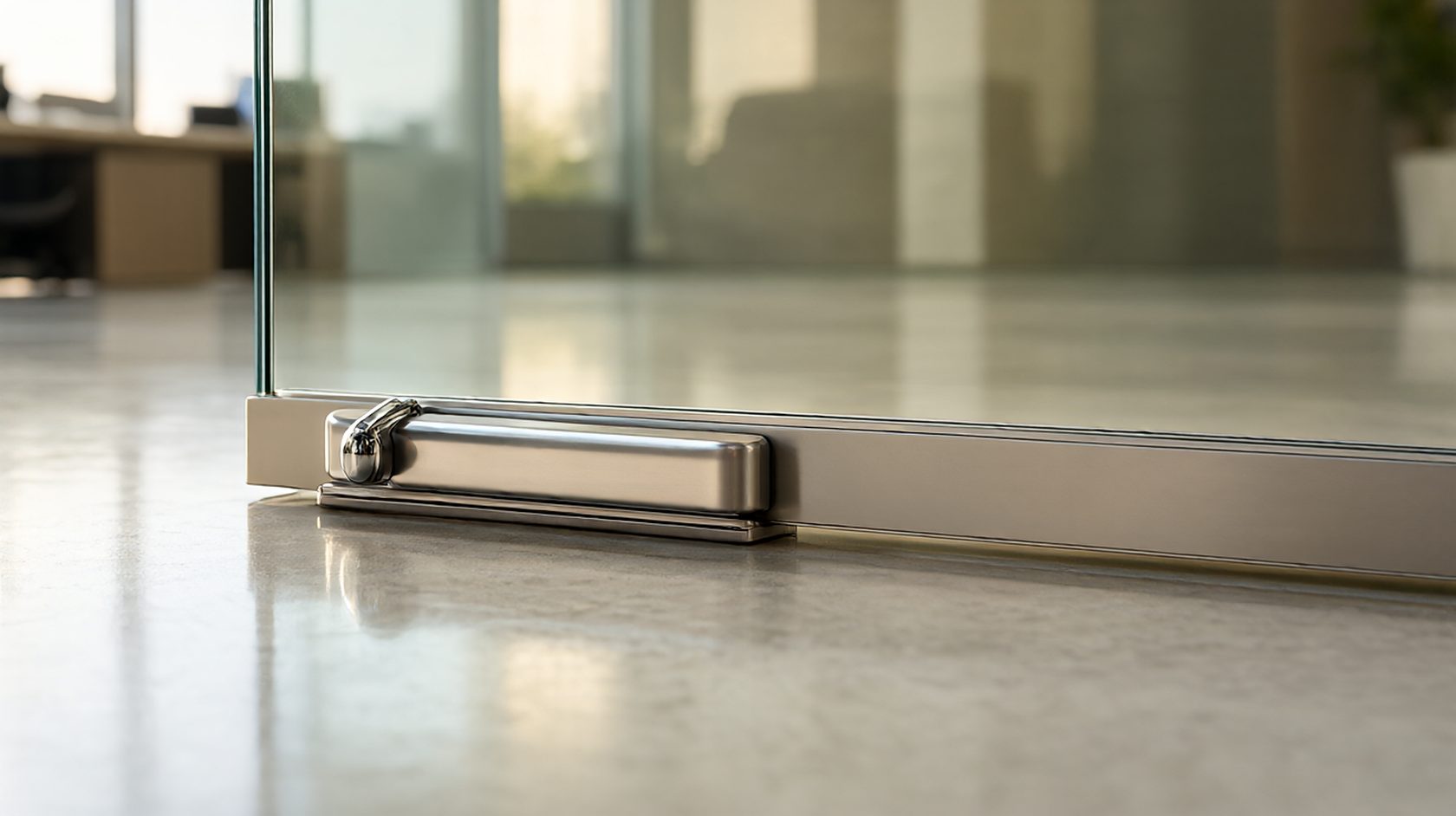
Two jobs in one fitting
A patch fitting does two things at once: it clamps the glass at a corner or an edge, and it anchors that corner to a floor pivot, a wall or another panel. The clamp is structural; the pivot is dynamic. Confusing the two is the source of most glass door problems.
The hydraulic bottom patch adds a third job: it damps the door's motion. Inside the fitting there is a spring, a cam and a hydraulic circuit with adjustable valves, and the whole assembly sits in a floor recess under the door. The glass hangs above it and the fitting carries the door's weight through a bearing.
That combination means the fitting is both a load path and a control device. It must be sized for the panel weight and the traffic, installed on a floor that will not move, and adjusted after installation by somebody who understands what each valve does.
What the adjustments actually control
Closing speed is the speed at which the door returns through most of its swing. It is set so a door takes three to five seconds to close from 90 degrees, which is fast enough to be convenient and slow enough not to trap a hand.
Latching speed is the last few degrees, where the door accelerates into the closed position so a latch engages. Too fast and the door slams; too slow and it stops short. It is a separate valve on better fittings, and it is the adjustment that most affects how the door feels.
Backcheck is a damping zone that resists the door being pushed open too fast, usually from about 70 degrees onward. It protects the wall, the glass and the person on the other side. Hold-open, where fitted, keeps the door at a set angle until it is pushed past a detent.
Those four behaviours share one small hydraulic circuit, and adjusting one moves the others slightly. The correct procedure is to set closing speed, then latching speed, then backcheck, then check hold-open, and to test after each adjustment rather than at the end.
Glass preparation: hole size, edge distance and the tolerance nobody allows
The patch clamps through a hole in the glass, and the hole is specified by the fitting manufacturer. The diameter matters within a millimetre, and the position matters more: the clamps need a minimum distance from the hole to the glass edge, and that distance is larger than most installers assume.
Tempered glass cannot be drilled or cut after tempering. Every hole, notch and edge is set before the tempering cycle, and any change afterwards means a new panel. This is why the hardware must be chosen before the glass is ordered, not after the frame is on site.
The tolerance chain is the practical problem: the hole position in the glass, the position of the floor recess, the position of the top pivot or the wall fitting, and the squareness of the opening. Each has a tolerance, and the sum decides whether the door hangs plumb. Allow for the chain in the setting-out, not in the adjustment range.
The floor is part of the fitting
A hydraulic bottom patch transfers the door's weight and the operating torque into the floor through a small area. A floor that is level but soft, or a screed that is not bonded, will move under that load, and the door will go out of plumb within a season.
The recess must be set at the right depth and must be clean, and the fitting must be grouted or anchored so it cannot rotate. A fitting that rotates in its recess changes the door's rest angle every time it is used, which presents as a door that will not stay closed.
On refurbishment, check the existing floor before ordering. A raised access floor or a floating screed may need a local slab or a through-bolt to structure; a fitting bolted to a floating floor is a fitting that will loosen.
Commissioning the door
Commissioning is four measurements and one observation. Measure the door's plumb in two directions, the gap at the top and the gap at the latch, then observe the close from 90 degrees three times and time it.
Set the closing speed first with the door empty, then repeat with the door at its normal weight - which is the door as installed, since glass doors do not carry loads. If the door has a lock, test the latch engagement at the latching speed setting; a door that closes softly and does not latch is worse than one that closes firmly.
Record the settings on the fitting or in the handover file. The next person to adjust it will otherwise start from zero, and the building will end up with a door that has been tuned by three different people to three different ideas of correct.
What fails, and when
The common failures are in a predictable order: the clamp screws loosen first, the door drops a few millimetres, the latch stops engaging. Then the hydraulic seal ages, the closing speed drifts, and the door starts to slam. Then the floor anchor loosens and the door goes out of plumb.
Each has an early symptom. A door that needs a lift to latch is a dropped door. A door that closes faster than it did last year is a seal. A door that swings open on its own is a lost rest angle, which is usually a rotating fitting.
The annual service is therefore not cosmetic: check clamp torque, check plumb, time the close, and look for fluid at the base of the fitting. Four checks, fifteen minutes, and the door lasts its intended life instead of being replaced at year six.
The recess, the cement and the door that drops
The floor recess is usually a cast-in box or a core-drilled pocket, and its depth decides how the fitting sits. Too shallow and the fitting stands proud, which changes the door's clearance and the sweep of the bottom edge; too deep and the fitting sits low, and the clamp may not clear the finished floor.
Grouting is the step that decides long-term alignment. A fitting set in a weak mortar will rotate or settle, and the symptom is a door that gradually loses its rest angle and starts to swing open. A fitting set in a proper grout, on a sound substrate, holds its position for the life of the door.
On refurbishment, the existing floor may not permit a recess at all. In that case the alternatives are a floor spring with a different footprint, a wall-and-floor pivot arrangement, or a framed door - and the decision needs to be made before the glass is ordered.
Where the top pivot belongs
A bottom patch carries the weight; a top pivot or a top patch locates the door. If the top fitting is badly positioned, the door will lean, the bottom bearing will take a side load, and the fitting will wear at one point.
The top fitting is usually a pivot in the header or a patch on a fixed panel, and its position is set by the door's geometry - not by where the ceiling structure happens to be convenient.
The tolerance chain between the bottom recess and the top pivot is the dimension that decides whether the door can be set plumb with the adjustment available. It should be measured, not assumed, and recorded at commissioning.
The handover line that saves a service call
Write the closing speed, the latching speed and the hold-open angle on a label inside the fitting cover or in the door file. The next engineer adjusts from a known baseline instead of guessing, and the building stops collecting three different ideas of correct.
The fitting described in this note - a recessed unit that carries both the clamp and the closer - is the office glass door bottom hydraulic patch, and it is the version to compare when the door needs speed control built in.
What to check
- Choose the fitting before the glass is tempered; holes cannot be added later.
- Allow for the whole tolerance chain: hole, recess, pivot, opening squareness.
- Set closing speed, then latching speed, then backcheck, testing after each.
- Check the floor - a floating screed needs a local slab or a through-bolt.
- Record the settings in the handover file and service the fitting annually.