Detail note · 18 November 2026
Choosing a shower hinge: weight, width and the number of cycles
A shower hinge is a load-bearing component disguised as a detail. Three numbers decide whether it lasts ten years or eighteen months: the glass weight, the door width and the cycles per day.
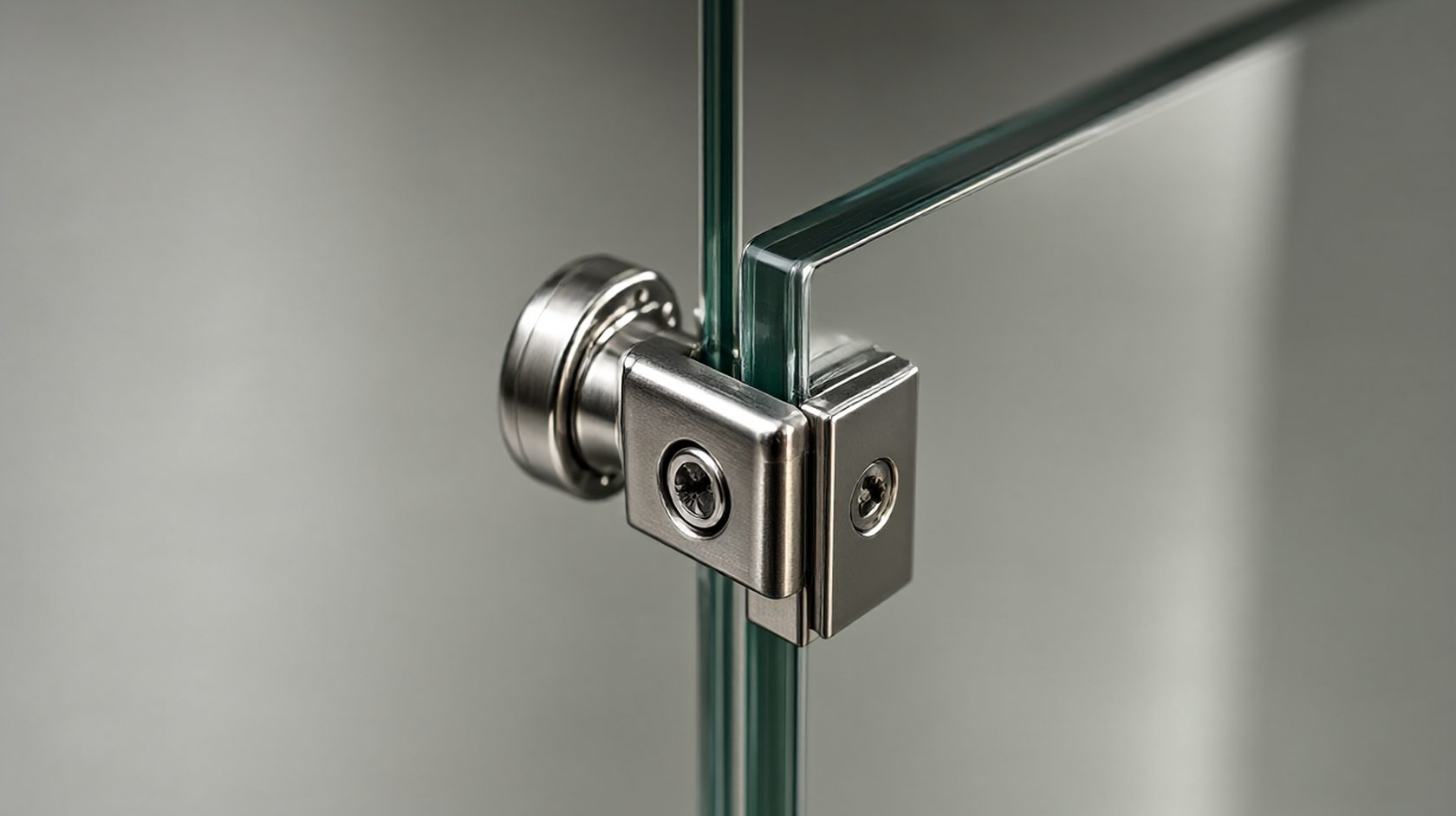
The three numbers that decide a hinge
Every hinge catalogue gives a weight rating per pair, and almost every hinge failure in the field traces to that rating being exceeded or misapplied. The rating assumes a door width, a glass thickness and a cycle count, and none of the three is obvious from the datasheet.
The first number is the glass weight. An 8 mm tempered panel weighs about 20 kg per square metre; a 10 mm panel about 25 kg. A 700 mm wide door that is 2,000 mm tall is 1.4 square metres, so 28 kg at 8 mm and 35 kg at 10 mm before any hardware. Two hinges share that, plus the dynamic load of a person pulling the door.
The second number is door width, because a wide door multiplies the moment at the hinge. The same panel at 900 mm produces roughly 30 percent more torque than at 700 mm, which is why a hinge rated for 40 kg is often specified only up to 800 mm.
The third is cycles. A family bathroom door might cycle twenty times a day; a gym or a hotel bathroom door cycles a hundred or more, and a hinge is a wear item that fails by fatigue, not by overload. A hinge specified on weight alone and installed on a high-traffic door is a hinge that will be replaced inside two years.
Glass thickness and the caliper question
The hinge clamps the glass, and the clamp has to be set for the actual thickness. Tempered glass is supplied within a tolerance, typically plus or minus half a millimetre, and a hinge designed for 8 mm with a fixed gap will either crush a 8.5 mm panel or slip on a 7.6 mm one.
The good hinge has an adjustable clamp with a gasket and a setting screw, and the installer should use a caliper on the panel rather than the label on the crate. This is a two-minute step that prevents the two most common field complaints: cracking at the clamp and a door that settles over months.
Edge distance matters as much as thickness. A hinge needs a minimum distance from the edge of the hole to the edge of the glass, and that distance is larger for 8 mm than for 10 mm because there is less material to spread the load. A hole placed by eye is a hole that will crack at the corner, months later, usually at night.
Self-closing, adjustable and raise-up-down
A self-closing hinge has a spring or a cam that returns the door to a shut position. It is the right choice for a shower door because it keeps the panel from swinging into a wet floor or a wall, and it lets the door rest closed without a latch.
An adjustable hinge lets the installer set the rest angle so the door sits square in the opening. This is the hinge to specify when the glass is not perfectly square or when the wall is out of plumb, which is most of the time. Adjustment range is typically a few degrees, and it is used up at installation, not over the life of the door.
A raise-up-down hinge lifts the door slightly as it opens, which lets a panel clear a sill or a bath edge without a gap at rest. It is a mechanical solution to a geometric problem and it wears faster than a plain hinge because the lift mechanism is a cam under load. Specify it when the geometry demands it, not because it sounds sophisticated, and check the cycle rating carefully on high-traffic doors.
The fixing is half the hinge
A hinge is only as good as what it is fixed to. Into a solid wall with a proper anchor, a hinge will hold its rating. Into tile over plasterboard with a plastic plug, the same hinge will move, and a moving hinge translates into a door that drops and glass that chips at the clamp.
The wall fixing needs a mechanical anchor, not a friction plug, and it needs to reach something structural. Where the wall is tiled over a stud, the anchor should land on the stud or a purpose-made backing plate. This is decided before tiling, not after, which is why glazing failures are often building failures wearing a hardware costume.
The glass-to-glass fixing is the other half. Two panels joined by a hinge exert a point load at the clamp, and a clamp tightened unevenly will load one side of the glass more than the other. The installation instruction to tighten in stages, alternating between the two screws, exists for that reason and is frequently ignored.
Installation sequence and the two-millimetre rule
The sequence that works: fix the wall hinge first, hang the door on it, then set the second hinge against the door in its closed position, then tighten the glass clamp, then adjust the rest angle, then test the swing.
Leave a gap between the door edge and any fixed panel or wall - typically 2 to 4 mm at the hinge side and a similar gap where the door meets the frame. A door installed with no gap will bind as soon as the building moves, and it will chip its own edge against the fixed panel.
Test the swing before the silicone goes on. Open the door through its full range by hand, listen for a click or a scrape, and check that the panel does not touch anything at any angle. Silicone hides a lot of errors and reveals them again six months later.
Maintenance and the squeak that means something
A hinge that squeaks is usually dry, not worn. Most hinges have a lubrication point or a sealed mechanism; the sealed ones need nothing, the others need a drop of silicone grease annually. A hinge that clicks has a loose clamp or a worn cam, and that is a different problem.
The annual check is three items: the clamp screws (are they at torque), the wall anchors (is there any movement when the door is pulled), and the glass edges around the holes (is there any sign of a star crack starting). Those three checks take five minutes and catch the failures before they become glass replacements.
The hinge replacement interval in commercial work is usually driven by appearance rather than function: the plating dulls, the door sags, the client notices. In residential work the hinge usually outlives the bathroom. In both cases the specification decision - weight, width, cycles - was made years earlier and is the reason the replacement is happening at all.
The pair shares the load, the glass does not
Two hinges do not halve the load in the glass; they halve the moment at each fixing. The glass around each hole still sees the full local load of that clamp plus its share of the door's weight and the pull.
That is why the hole pattern, the gasket and the clamp tightness matter more than the weight rating alone. A hinge rated for 45 kg on a 35 kg door can still crack the glass if the clamp is tightened unevenly or the gasket is missing.
The pair is also a kinematic pair: the two hinges must be parallel. A door hung with one hinge slightly out of line will bind through part of its swing, and the binding load goes straight into the glass at the clamps.
Two hinges or three, and where the third goes
A tall door on a narrow panel is the case for a third hinge: the middle hinge reduces the unsupported span and therefore the deflection of the glass under its own weight.
The third hinge must be aligned with the other two within a fraction of a millimetre, or it will fight them and load the glass at three points. Adding a hinge to a problem door without aligning it is how a door becomes worse.
The rule of thumb on height is that a panel over about two metres benefits from three hinges regardless of width, because the glass itself is the structural member and its deflection grows with the cube of the span.
A hinge that offers the adjustment range described here, with a clamp that accepts 8 to 10 mm glass, is the raise-up-down adjustable shower hinge used on this kind of panel - a sensible starting point when the rest angle has to be set on site.
What to check
- Calipers on the glass, not the crate label.
- Check the hinge rating at your door width, not just the weight.
- Count cycles per day for commercial doors; specify for them.
- Mechanical anchors into structure, not friction plugs into tile.
- Test the full swing before silicone, with a 2-4 mm gap at the hinges.