Detail note · 18 November 2026
Towel bars and handle combinations: the pull-out load that decides the fixing
A towel bar is a lever on a glass panel, and people pull on it. The fixing that survives a towel is often not the fixing that survives a person steadying themselves, and the difference is in the glass.
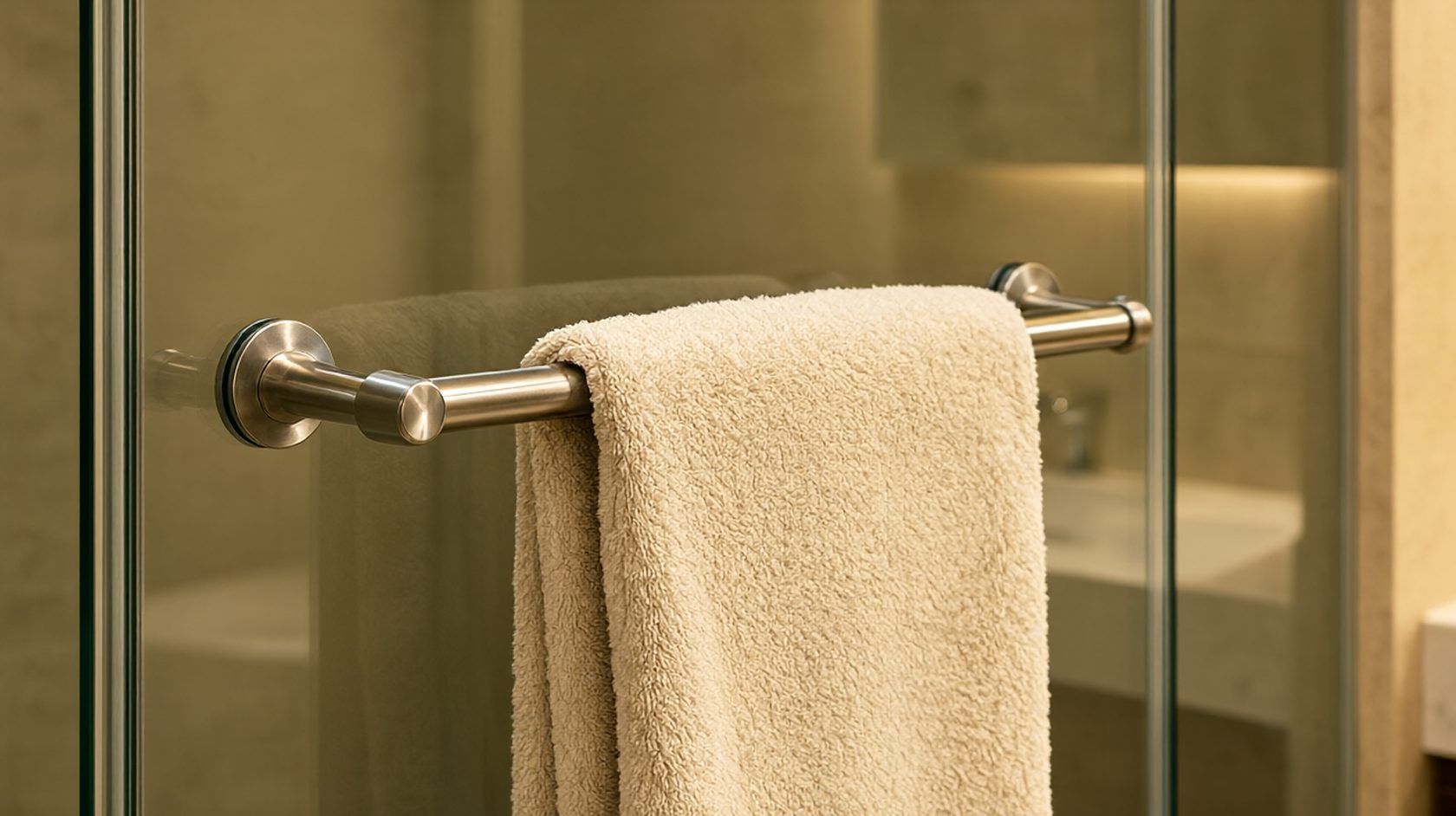
The load case nobody specifies
A towel bar is specified by length, finish and style, and it is loaded by a wet towel, which is light. The load case that actually matters is the one where somebody grabs the bar to steady themselves, or hangs a wet coat on it, or pulls the door shut by it.
That grab load can be 300 to 500 newtons applied at the end of the bar, which turns the bar into a lever and puts a moment into the fixing and into the glass. A bar mounted on a glass panel with two small holes and no backing plate is a bar that will eventually chip the glass at the fixing.
The handle combination - a bar that also works as the door handle - is the more demanding case, because it is pulled every time the door is used, in the direction that loads the fixing in peel rather than in shear.
Fixing into glass versus fixing into wall
A bar fixed to a wall transfers the load into masonry or studs and the glass is untouched. A bar fixed to a glass panel transfers the load into the panel, and the panel transfers it to its own fixings - the hinges or the clamps. The chain is only as strong as its weakest link, and the glass is brittle.
The glass fixing must use a clamp with a gasket and a hole sized to the fitting, at the manufacturer's minimum edge distance. Two small holes close to the edge of a panel are the classic failure: the glass chips at the hole and a crack runs to the edge.
Where the bar is on a door, the load also goes through the hinges. A towel bar on a hinged door increases the effective weight and the moment at the hinge, which is a reason to check the hinge rating after the bar is added rather than before.
Bar length, projection and the lever arm
The projection of the bar from the glass is the lever arm. A bar that projects 60 mm puts half the moment into the fixing of a bar that projects 120 mm, for the same pull. Deep bars look generous and load the glass more.
The length matters for a different reason: a long bar invites a two-handed pull and a heavier load. A 600 mm bar on a shower door is a towel rail; a 900 mm bar is a grab rail in practice, whether or not it was specified as one.
The practical rule is to keep glass-mounted bars short and close, and to use wall-mounted bars for anything that will be pulled hard. Where the design requires a long glass-mounted bar, the fixing should be a plate with multiple holes rather than two point fixings.
Holes, gaskets and the tempering sequence
Every hole in tempered glass is made before tempering. A bar specified after the glass is ordered means either a new panel or a bar mounted with adhesive - and adhesive on a wet bathroom surface is a temporary solution.
The hole pattern should come from the bar manufacturer as a drawing, with the diameter, the centres and the minimum edge distance. Giving the glass supplier a verbal description of the bar is how holes end up 10 mm off and the bar cannot be installed.
Gaskets at every glass-to-metal contact are not optional. They protect the glass from point loads, isolate dissimilar metals, and keep water out of the fixing, which is where corrosion starts in a bathroom.
Installation and the water problem
The installation sequence is: mark the holes from the drawing, verify with the bar in place before drilling anything, drill with the correct bit and coolant, fit the gaskets, tighten in stages, then test the bar with a firm downward pull before the door is hung.
Water is the long-term enemy. A fixing that collects water will corrode, and a bar that is loose will let water behind the gasket. Silicone around the fixing is not a substitute for a tight clamp; it is a supplement.
On a shower door, the bar is in the wettest part of the building. The finish should be one that tolerates daily water and weekly cleaning, and the fasteners should be stainless rather than plated, because plated fasteners fail at the edges first.
Maintenance and the loose bar
A bar that moves when pulled is a bar that is on its way to a glass failure. The monthly check is a firm pull at the end of the bar, and the annual check is a look at the glass around the holes for a star crack or a chip.
The clamp screws should be checked at the same time, because a bar that has been pulled repeatedly will loosen them gradually. A torque check once a year is enough in a residential setting and twice a year in a hotel or gym.
Replacement is straightforward if the holes are sound; it becomes a glass replacement if they are not. That is the whole argument for specifying the bar and the glass together, and for treating the bar as a structural accessory rather than a finishing touch.
The grab-rail question and the accessible bathroom
A towel bar is not a grab rail, and treating one as the other is a safety issue rather than a specification nuance. A grab rail has a defined load case, a defined fixing and a standard it is tested against.
If a bathroom needs a grab rail, it needs a grab rail fixed to structure - not to glass, and not a bar that happens to be in reach. The two can look similar in a rendering and are entirely different products.
Where a bar and a handle are combined on a glass door, the combination should be specified for the pull direction it will actually see: the handle pull is horizontal, the towel pull is often downward, and the grab is usually diagonal. The fixing should be sized for the diagonal case.
The design decision that reduces the risk
Keep the glass-mounted bar short and close to the panel, and put the long bars on walls. That single decision removes most of the load cases that crack glass.
Where the design insists on a long bar on glass, use a plate fixing with four holes rather than two, and check the hinge rating again afterwards. The bar changes the door's effective weight and its moment, and the hinge was specified before the bar existed.
Hinge rating after the bar is added
A bar adds weight at the far edge of the door, which is the worst place for it. The hinge sees a larger moment, and a door that was within rating before the bar may be outside it afterwards.
The check is simple arithmetic: door weight plus bar weight, door width unchanged, moment increased. If the hinge was specified close to its limit, the bar is the reason it will fail early.
This is the argument for choosing the bar with the hinge, in the same schedule, rather than as a finishing item ordered by somebody else.
Cleaning and the finish that survives a bathroom
Bathroom cleaning products are often acidic, and acidic cleaners attack plated finishes and can stain brass. A brushed stainless bar tolerates most of them; a chrome-plated bar tolerates fewer.
The specification should name the cleaning regime, because the maintenance team will use what is on the trolley. A finish that requires a special cleaner is a finish that will be cleaned with the wrong one.
Water marks are a maintenance issue rather than a material issue. A squeegee and a microfibre cloth cost less than a replacement bar, and they are the difference between a finish that looks new at year five and one that looks tired at year two.
The combination that solves the two problems at once - a bar that is also the handle - is the towel bar and handle combination used on shower doors, and its projection is the lever arm to keep short.
What to check
- Glass-mounted bars: short, shallow projection, plate fixings not two points.
- Get the hole drawing from the bar maker before the glass is tempered.
- Gaskets at every glass-to-metal contact; stainless fasteners in wet areas.
- Test with a firm end-of-bar pull before hanging the door.
- Check clamp torque annually; a moving bar precedes a cracked hole.